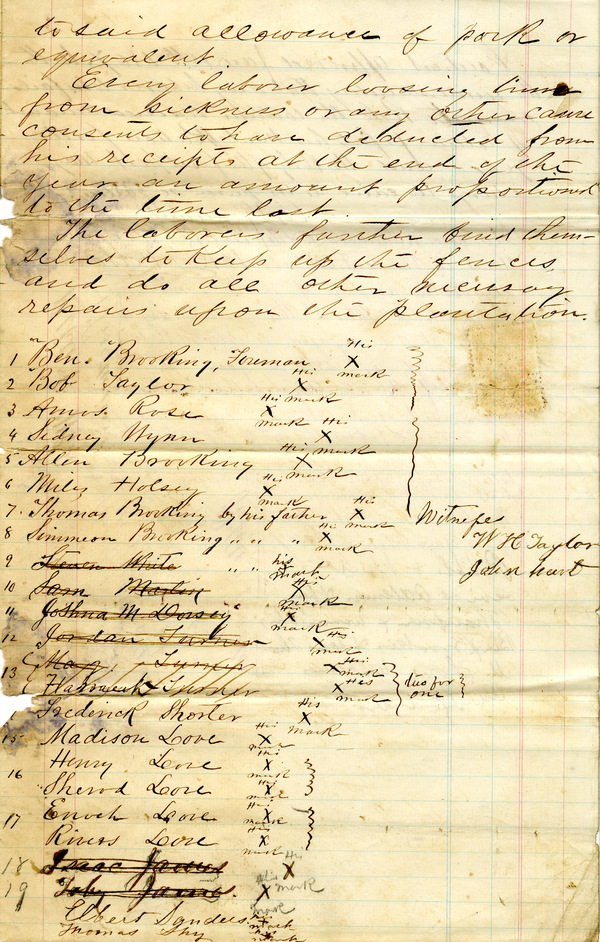
JEFFERSON COUNTY, FLORIDA. When Rivers Love first entered the surviving written record, he was probably not yet twelve years old. The year was 1867, only two years after slavery had ended, and his name appeared among freed Black laborers attached to a crop-sharing agreement on the Wirtland Plantation in Jefferson County. The contract itself does not give Rivers’s age, but the 1880 federal census later recorded him as 25 and placed his birth around 1855. Using that census estimate, Rivers would have been about eleven when the agreement took effect on January 1, 1867, and would have turned twelve sometime during that year.
That age changes the way the document reads. The name “Rivers Love” appears among adults and other laborers bound to a demanding agricultural agreement, yet the later census suggests that Rivers was still a child when the contract began. Nothing in the surviving document separately identifies him as a juvenile or adjusts its obligations because of his age. Instead, his name sits within a labor system that required workers to rise with the agricultural day, tend crops and animals, maintain the plantation and meet production requirements set by men who controlled the land.
Jefferson County provided the setting for that early life. Located immediately east of Tallahassee and extending north to the Georgia line, the county occupied some of North Florida’s richest agricultural land. Cotton had shaped the region before the Civil War, and the end of slavery forced landowners and Black laborers into new arrangements over wages, food, housing and crops. Emancipation changed the legal status of people who had lived under slavery, but it did not transfer plantation land or erase the economic imbalance between people who owned acreage and people whose principal asset was their labor.
The Freedmen’s Bureau became one of the institutions attempting to manage that transition. Florida Memory’s surviving Jefferson County contracts show landowners and laborers entering written agreements that described work obligations, crop divisions, food allowances and rules governing everyday conduct. Local Bureau officials reviewed contracts and sometimes amended them, creating a documentary record of freedom as it operated not in constitutional language, but in fields, kitchens, livestock pens, cotton rows and account books.
For Rivers Love, that system forms the beginning of a life that would eventually move through nearly every layer of North Florida’s criminal justice machinery.
A Boy’s Name in an Adult Labor Contract
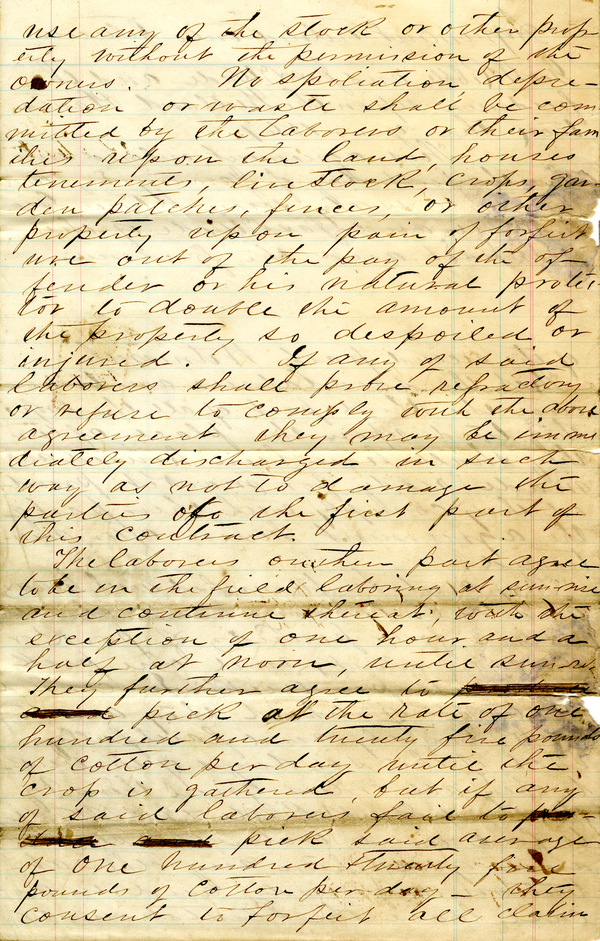
The Wirtland Plantation agreement began on January 1, 1867, between George W. Ribble and James D. Wade on one side and the freed laborers on the other. The workers were promised one-third of the crops after they had gathered, housed and prepared them for market. The employers agreed to furnish housing and provide each laboring hand with four pounds of pork or its equivalent and a peck of meal each week. In return, the workers agreed to labor six days a week, follow orders, feed and water livestock, maintain fences and perform other necessary plantation work.
The agreement reached far beyond a general promise to work. It regulated movement from the plantation and allowed deductions for time lost to sickness or other causes. During cotton-picking season, it imposed a target of 125 pounds per laborer per day and threatened the loss of meat allowances when workers failed to meet the required average. An August addition tried to account for rainy days by requiring workers to compensate with heavier picking on fair days, demonstrating how closely the employers and federal officials attempted to calculate labor productivity.
If Rivers was born about 1855, as the 1880 census indicates, he entered this agreement at roughly eleven years old. Even allowing for the uncertainty common to nineteenth-century census ages, the chronology places him firmly in childhood or very early adolescence when his name appeared among the Wirtland laborers. The contract therefore offers more than a genealogical clue; it places a Black child growing up in the first years after emancipation inside a labor arrangement built around cotton production and plantation discipline.
Several other people named Love appear beside him. Florida Memory indexes Madison Love, Henry Love, Sherod Love, Enoch Love and Rivers Love, while the manuscript includes Madison Love’s notation for his sons. Madison Love was Rivers Love’s father, and he signed the 1867 Wirtland contract on behalf of his sons. That identification places Rivers within a documented family group on the Wirtland agreement: Rivers, Enoch and Sherod appear together in the 1867 contract, and newspapers more than twenty years later explicitly called Enoch and Sherod Rivers’s brothers. The names on the worn pages did not disappear when Reconstruction ended. At least three of the Love men would reappear in the public record decades later, this time through sheriffs, courtrooms and newspapers rather than agricultural contracts.
Ages in the surviving record
Following Rivers Love Across Twenty-Three Years
The 1880 census recorded Rivers Love as 25 and estimated his birth in 1855. Ages before and after 1880 are therefore approximate unless a record gives an age directly.
The 1885 census gives Rivers a different estimated birth year, 1859. Because the 1880 federal census specifically recorded him as 25, this article uses the 1855 estimate as the primary age reference while noting the conflicting 1885 entry.
The Love Family Moves East
By 1880, Rivers Love had grown from the boy whose name appeared in the Wirtland agreement into a husband, father and household head. The federal census found him in Greenville in Madison County, east of Jefferson County, and recorded him as a 25-year-old Black laborer born in Florida. His wife appeared as Conelia Love, age 20 and born in South Carolina, while their daughter Ida was two.
The census gives a view of Love that disappeared almost completely once newspapers began reporting his crimes. He worked for a living and shared a household with his wife and young daughter. No sheriff, prison official or court reporter mediated that description. In a single census line, Rivers existed as millions of other people did: through age, occupation, marriage, birthplace and family.
Five years later, the Florida state census placed Rivers and Cornelia in Leon County, bringing the family into the Tallahassee area. The state census recorded Rivers as 26 and Cornelia as 24. The record gave Rivers’s birthplace as South Carolina and estimated his birth around 1859, conflicting with the federal census that had placed his birth around 1855 in Florida. The inconsistency should remain visible rather than being forced into a false resolution. Census ages and birthplaces often shifted because information came from different household members, neighbors or enumerators, and indexing introduced another possibility for error. The continuity of Rivers and Cornelia across neighboring counties is much stronger than the precision of either birth-year estimate. Because the 1880 federal census explicitly recorded Rivers as 25, this article uses about 1855 as the working birth year while treating later calculated ages as approximate.
From Laborer to Prisoner
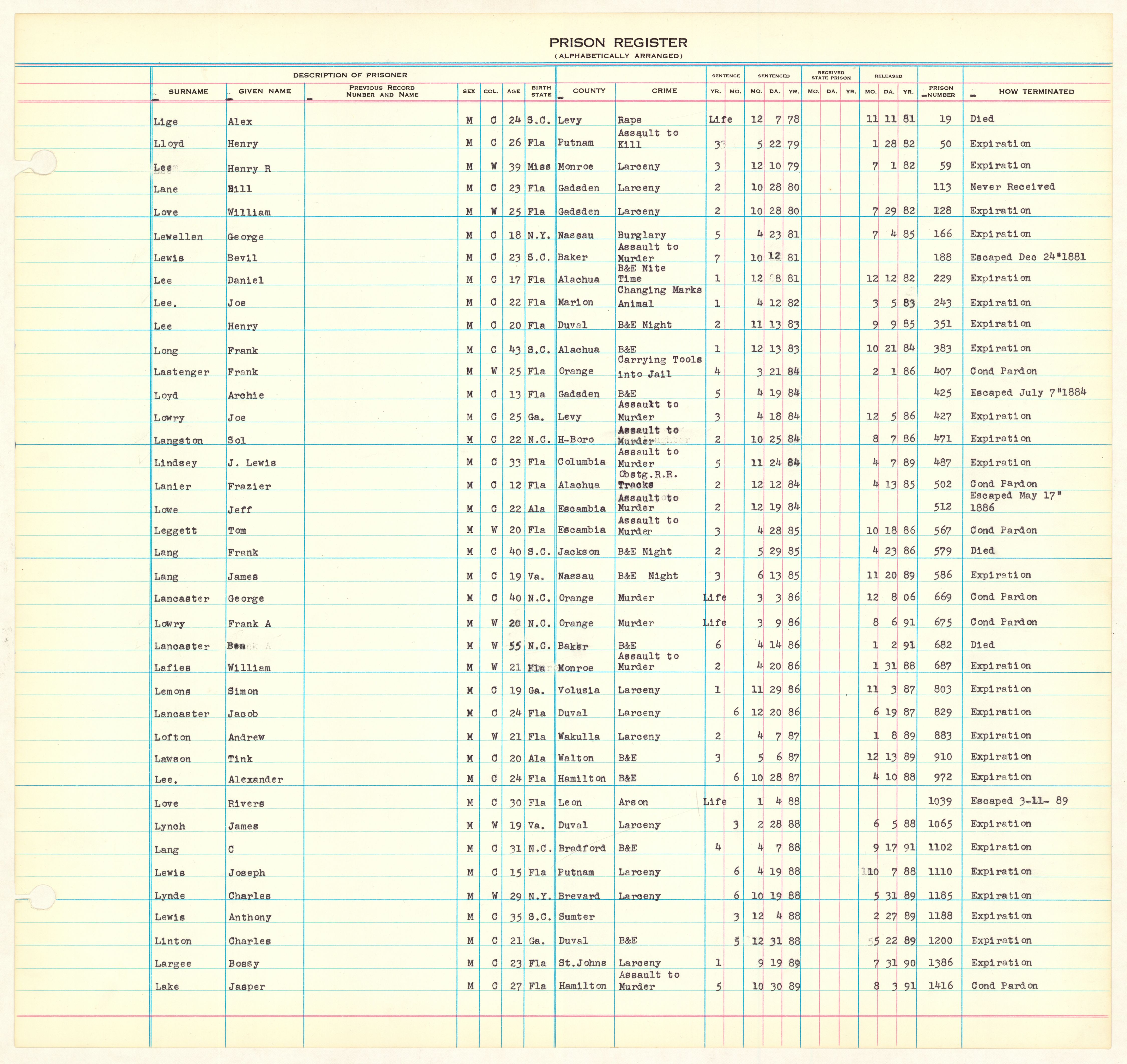
By 1887, when Rivers was probably about 31 or 32, the surviving record changed sharply. The Weekly Floridian reported on June 2 that authorities had captured him and charged him with setting fire to a building associated with railroad property near the Tallahassee depot. The brief account did not provide a detailed account of the fire, but later newspapers established that the prosecution ended with a life sentence.
By March 1889, the Quincy Herald described Rivers as serving life imprisonment for burning a building at the Tallahassee shops of the F. R. & N. Company. The paper also reported that he escaped on June 27 of the previous year, which places that escape on June 27, 1888 if the paper’s retrospective dating was correct. Rivers would have been about 32 or 33 under the 1855 birth estimate.
An escaped prisoner serving life for arson presented authorities with a serious problem, but Rivers did not simply vanish into another state. He returned to the region where his family ties remained strongest. Newspapers soon connected him with the burglary of a store owned by a man named Loeb in Monticello, the Jefferson County seat where his story had begun in the Reconstruction labor system.
Sheriff Simkins investigated the Monticello burglary and captured Rivers together with Enoch and Sherod Love. Newspapers specifically identified the two men as Rivers’s brothers, providing the strongest independent support for linking three of the Love names in the 1867 labor contract to the same family. Enoch and Sherod remained in custody for the burglary prosecution, while officials returned Rivers to state prison because he already owed the state a life sentence.
That return did not hold him for long. A later report said Rivers escaped again in less than two weeks and moved back toward Jefferson County, where several of his brothers lived. By the spring of 1889, Love had acquired a reputation not simply as a convicted man, but as someone who repeatedly defeated confinement and returned to familiar territory after doing so.
North Florida locations
A Life Along the North Florida Corridor
Rivers Love’s documented life remained concentrated across a relatively narrow stretch of North Florida. Each location marked a different stage of his life, from agricultural labor and family residence to prosecution, prison and execution.
- TallahasseeArson prosecution
- MonticelloJefferson County and burglary
- Greenville1880 household
- MadisonTrial, jail, and execution
- Live OakCornelia and children, 1900
The Mystery of J. C. Powell’s “Sol Love”
Rivers Love’s repeated escapes create an intriguing connection with J. C. Powell’s memoir The American Siberia. Powell, who served within Florida’s convict system, described another prisoner surnamed Love in a story about a prison brick yard at Live Oak. He called the man Sol Love, described him as an experienced escapee and portrayed him as clever enough to turn a guard’s generosity into an opportunity for an entire work squad to flee.
Powell wrote that Major Wise established the Live Oak brick yard and assigned eight prisoners to a guard named Hurst. During a hot day, Hurst obtained buttermilk for the men. According to Powell, Sol Love lingered with the guard while the others drank, kept Hurst occupied with conversation and waited until several prisoners began running before slipping away in the opposite direction. Powell remembered Love as someone who had escaped before and understood how to manipulate the confusion around him.
The pursuit carried Powell, Major Wise and a guard named McIntyre toward Sanderson. Powell said they encountered three prisoners near a railroad bridge after dark and captured two, Peter Reddick and George Gomez. The third man, whom Powell identified as Sol Love, ran. Powell and Wise fired their pistols, saw the fugitive appear to stumble, and then lost him in the darkness.
Powell claimed the searchers found blood the next morning and traced the wounded man toward a swamp before losing the trail. He then said that about two weeks later they learned Love had reached a house near St. Marys and died from the wounds. In Powell’s telling, that death ended the story of Sol Love. Rivers Love presents an obvious comparison. Both men carried the surname Love, both passed through Florida’s convict system, both developed reputations for escape, and both belonged to the same North Florida geographical world. Rivers’s later family also settled in Live Oak, making Powell’s choice of location even more arresting.
The evidence nevertheless prevents a confident identification. Rivers was alive in 1887, 1888, 1889 and 1890, while Powell said Sol Love died after the Live Oak escape. If Powell meant Rivers, he would have misremembered both the first name and the fate of the prisoner, or he would have combined separate episodes into a single narrative. Memoirs can produce exactly that kind of compression, but no surviving prison register or contemporary newspaper currently proves that it happened here. For that reason, the connection should remain a question rather than a discovery. Powell may have known another prisoner named Sol Love, or he may have preserved a distorted memory involving Rivers or one of the other Loves. The resemblance is substantial enough to justify further archival work, but not substantial enough to erase Powell’s “Sol” and replace it with “Rivers.”
Thomas Braswell Is Killed
Contemporary Newspaper Reporting
Read The Original Newspaper Accounts
These full newspaper files preserve the reporting used to reconstruct the Braswell investigation, capture, trial, and aftermath.
By the spring of 1889, Rivers was approximately 33 or 34 years old and again outside state custody. In Madison County, an older man named Braswell was attacked and robbed at his home, and the crime immediately drew intense local attention. Surviving newspapers disagree over the victim’s full name, with different accounts referring to John Braswell, T. M. Braswell and Thomas Braswell, but the later trial and execution reporting consistently connects Rivers Love’s murder conviction with the Braswell killing.
The earliest descriptions did not present Rivers as a proven killer. Reporters described a violent attack, the apparent theft of a substantial amount of money and a community searching for clues. As suspicion developed, however, Love’s existing status as an escaped life prisoner made him an obvious focus for investigators and newspapers alike.
By April, reports said some residents believed Rivers had killed Braswell or participated with others in the crime. The amount allegedly taken was reported at roughly $900, a considerable sum in 1889, and rewards soon added financial incentive to the search.
Sheriff Simkins built the investigation around Rivers and another man, Frank Brooks. An August account said witnesses had seen Rivers talking with Braswell before the killing and that investigators became suspicious of Brooks after he appeared to have money and sought weapons. Rather than attempt to approach Brooks directly, authorities reportedly brought a Black detective from Atlanta into the investigation, hoping he could gain Brooks’s confidence without immediately revealing his purpose.
The newspaper described the detective spending time with Brooks until he learned more about the relationship between Brooks and Rivers. Investigators subsequently searched locations associated with the men and reported finding weapons, clothing, ammunition, a satchel, papers and other objects that they considered potentially relevant. Those newspaper descriptions provide important detail about the investigation, but they should not be mistaken for a complete trial record. The surviving reports do not allow every object to be tied confidently to the murder or every prosecution theory to be reconstructed.
What eventually became legally certain was the verdict. A jury convicted Rivers of first degree murder and Frank Brooks of second degree murder, treating the two men as criminally responsible at different levels. That distinction suggests the evidence or prosecution theory assigned Rivers the more serious role, but without a complete trial transcript it would be inappropriate to invent the exact acts the jury believed each man committed.
A fugitive becomes a public spectacle
As the Braswell investigation continued, Rivers remained outside custody. Newspaper descriptions of the search increasingly treated him as an outlaw figure, blending crime reporting with the dramatic language that editors often used when describing fugitives. One surviving account followed Rivers into Thompson’s Valley and introduced Brad Hampton, a man who had previously shared a jail cell with him.
Hampton apparently became interested in capturing Rivers only after the governor offered a $250 reward. According to the newspaper, he purchased a rifle and set out to find the man he had known in jail, believing their familiarity might allow him to approach without immediately raising suspicion. The story’s tone mocked Hampton’s ambitions, comparing the hunt with the exaggerated adventures associated with western desperadoes.
The episode shows how far Rivers’s reputation had traveled. By then, law enforcement officers were not the only people searching for him. A reward had transformed the fugitive into a financial opportunity, and his repeated success at escaping custody helped newspapers turn the manhunt into serialized entertainment.
The surviving clipping’s headline indicates that Hampton’s effort ended badly for the would-be captor, describing Rivers as turning the situation on the “so-called detective” and taking his rifle. The account contributes another episode to a pattern already established by the prison escapes: Rivers repeatedly used familiarity, timing and the mistakes of other men to remain free.
Sheriff Simkins finds him in the cotton fields
Sheriff Simkins eventually learned that Rivers was staying with Arthur Nicholson in Thompson’s Valley. He deputized C. W. Henry, P. B. Bird and John Johnson and moved toward a small cotton field surrounded by dense swamp. The newspaper described the field as about twenty acres, with a log shanty standing inside it, a landscape that offered both concealment and multiple routes toward cover.
Rain helped the sheriff narrow the possibilities. Simkins apparently believed people who had been picking cotton would have taken shelter inside the shanty, so he positioned his deputies and approached the cabin. When he came within roughly thirty feet, Rivers emerged and heard him moving nearby.
Simkins ordered Rivers to stop and covered him with a pistol. The newspaper said Rivers moved backward toward the doorway, apparently trying to reach a rifle positioned just inside, but the deputies stepped around the building and brought their own rifles to bear before he could get it. Simkins then moved forward and handcuffed him.
For all the fear surrounding him, Rivers possessed almost nothing when officers searched him. The newspaper reported six cents, a pocketknife and a bunch of keys. It also observed that he had gained considerable weight while living outside custody, an indication that he had found food, shelter and assistance during the months in which officers struggled to locate him.
The Trial of Rivers Love and Frank Brooks
The Braswell prosecution reached the Madison County Circuit Court in October 1889. Rivers, now about 34 under the 1855 birth estimate, faced the possibility of a death sentence, while Frank Brooks stood accused alongside him. Savannah’s Morning News reported that the court devoted much of the week to the case before the jury began deliberating Friday night.
The verdict came Saturday morning. Jurors found Rivers Love guilty of murder in the first degree and Frank Brooks guilty of murder in the second degree. Judge White sentenced Rivers to hang and Brooks to life imprisonment. The newspaper identified Alexis M. Michelson of Madison as Rivers’s attorney and R. H. Long of Tallahassee as Brooks’s counsel.
The difference in verdicts matters. Both men faced prosecution for Braswell’s death, yet the jury imposed the highest degree of murder on Rivers while convicting Brooks at a lesser degree. The surviving newspaper accounts do not provide enough detail to reconstruct precisely why the jurors made that distinction, so a defensible account must stop at the legal outcome rather than invent a sequence of blows, roles or admissions unsupported by the available evidence.
A death sentence still did not keep Rivers inside the Madison jail. In November 1889, newspapers reported that he escaped by filing through the bars, leaving the state once again searching for a man who had already escaped from a life sentence and had now escaped after receiving a death sentence. The governor renewed the financial incentive for his capture with a $250 reward.
His repeated escapes became the defining feature of his public reputation. Authorities had captured him after the Tallahassee arson case, returned him after an earlier prison escape, captured him after the Monticello burglary, returned him to prison again, arrested him in Thompson’s Valley during the Braswell investigation and placed him under a death sentence in Madison. Each confinement created another opportunity for flight.
Custody and flight
Repeated Custody, Repeated Escape
- 1887Arrested in Tallahassee arson case→Life sentence and state prison custody
- June 27, 1888Reported escape→1889 recapture after the Monticello burglary
- 1889Returned to prison and escapes again→Captured in Thompson’s Valley
- October 1889Sentenced to hang→November 1889 escape from the Madison jail
- March–April 1890Final recapture→Execution at Madison
The Final Weeks
Rivers remained at large into the spring of 1890. A Morning News report published on April 3 said authorities had recaptured him the previous Thursday, which places the final capture on March 27, 1890. By then, the capital conviction remained in force and no new murder trial was necessary.
The timing was severe. Rivers had spent months avoiding the death sentence, but after his recapture fewer than seven days separated him from execution. He was approximately 34 or 35 years old if the 1855 census estimate is used, meaning that only about twenty-three years separated the boy whose name appeared in the Wirtland labor contract from the condemned man returned to Madison jail.
On April 2, 1890, Madison County carried out the sentence. The Morning News reported the next day that Rivers Love had been hanged at the jail for the murder and robbery of Braswell. County officials and approximately twenty-five citizens witnessed the execution.
The execution date deserves emphasis because later compilations have sometimes reproduced inconsistent dates. The contemporary Morning News report appeared on April 3 and described the hanging as having occurred the previous day, fixing the execution at April 2, 1890. A contemporary newspaper published immediately after the event provides stronger chronological evidence than later lists that occasionally give another April date.
The hanging ended Rivers Love’s life but not his family’s history. Newspapers could close the story with the execution because crime reporting followed defendants until punishment. Census takers, however, returned ten years later and found the people who had lived beyond him.
Cornelia Love Rebuilds a Household in Live Oak
In 1900, Cornelia Love lived in Live Oak, Suwannee County, east of Madison. The federal census identified her as a Black widow and head of household. It recorded her as 32 years old, though that age conflicts with the earlier 1880 and 1885 census entries, and stated that she had given birth to six children, four of whom were still living.
Her household included children who carried the Love name into the next century. Richmond Love was 14 and Roselten Love was eight. Most strikingly, an eleven-year-old son was named Rivers Love.
The younger Rivers’s census entry gives a birth date of December 1889. If correct, Cornelia gave birth to a son bearing his father’s name while the elder Rivers was under a death sentence and during the period surrounding his final escape from Madison jail. The child would have been only a few months old when his father went to the gallows on April 2, 1890.
That detail transforms the end of the story. Rivers did not disappear from the historical record simply because a sheriff closed a jail door or a hangman carried out a sentence. Cornelia continued raising their children, and the name Rivers Love survived in a boy who grew up without the father from whom he received it.
Live Oak also brings the story back to J. C. Powell’s memoir in an unexpected way. Powell had placed his mysterious “Sol Love” at a prison brick yard in Live Oak years earlier, while the documented Rivers Love family later made the town its home. That geographic overlap does not resolve the identity problem, but it makes the coincidence difficult to ignore and adds another reason to search future prison registers, county records and labor files for the Love family.
A Life Reconstructed from Institutions
Rivers Love never left a memoir of his own, at least none has surfaced in this research. Almost everything now known about him comes from institutions that wanted something from him or exercised power over him: plantation employers wanted labor, census takers wanted household information, sheriffs wanted custody, prison officials wanted confinement, prosecutors wanted conviction and newspapers wanted a story.
Reading those sources together produces a fuller man than any one of them alone. The 1867 labor contract shows a boy growing up in the first years after emancipation. The 1880 census shows a 25-year-old laborer with a wife and daughter. The 1885 census shows a married father in Leon County. The later newspapers show a man convicted of arson, sentenced to life, repeatedly escaping custody and eventually convicted of murder.
Nothing in that fuller biography requires turning Rivers into a romantic outlaw. A jury convicted him of first degree murder, and the available record gives no basis for simply dismissing that judgment. At the same time, the conviction need not erase everything that came before it. His life did not begin with Braswell’s death, and his family’s life did not end with his execution.
The story becomes more historically meaningful precisely because the sources resist a simple label. Rivers Love was a Black child in a Reconstruction labor contract, a worker, husband and father, a convicted arsonist, a repeat prison escapee, a fugitive, a murder defendant and a condemned prisoner. All of those descriptions belong to the same life.
Chronology
The Life of Rivers Love
Birth Estimated birth year from the 1880 federal census.
About 11 Named in Wirtland Plantation freedmen’s labor contract.
25 / recorded as 26 Household, labor, marriage, and family records in Greenville and Leon County.
About 31–34 Arson arrest, life sentence, repeated escapes, and Braswell prosecution.
About 34 First-degree murder conviction, death sentence, and jail escape.
About 34–35 Final recapture and execution at Madison.
Family after Rivers Cornelia appears as a widow in Live Oak with four living children.
Approximate ages use the 1880 census estimate of an 1855 birth year. The 1885 state census contains a conflicting age and birthplace and should not be used to manufacture false precision.
What Remains Unanswered
Further family research has resolved the identity of “M. Love” in the 1867 contract as Madison Love, Rivers Love’s father. Other questions remain open. Prison commitment records could clarify the Tallahassee arson sentence, while Madison County court records might reveal more about the evidence that produced different murder verdicts for Rivers and Frank Brooks. The greatest unresolved question remains Powell’s “Sol Love.” The similarities are significant enough that dismissing them would be premature, but Powell’s claim that Sol died after the Live Oak escape contradicts the documented life of Rivers. A prison register identifying Sol Love independently would settle much of the problem, while a record placing Rivers in the Live Oak brick crew could transform the comparison entirely.
The surviving sources already establish something important. Rivers Love’s life can now be followed across more than two decades, beginning when he was probably about eleven years old and ending when he was about thirty-five. That span moves through emancipation, plantation labor, family formation, railroad expansion, Florida’s convict system, rural law enforcement and capital punishment, making his biography a remarkably concentrated window into North Florida after the Civil War.
Acknowledgment of Sources
Carceral Collections gratefully acknowledges the State Archives of Florida and Florida Memory for preserving the 1867 Jefferson County freedmen’s contract that makes it possible to see Rivers Love before the criminal record consumed his public identity. Florida Memory’s transcription and digitization of the Ribble and Wade agreement provide the foundation for understanding the Love family’s Reconstruction-era labor history, including the names Madison, Henry, Sherod, Enoch and Rivers Love and the corroborated identification of Madison Love as Rivers’s father.
This reconstruction also depends heavily on FamilySearch and the National Archives and Records Administration, whose census material preserves Rivers, Cornelia and their children across the 1880, 1885 and 1900 enumerations. Those records provide the working 1855 birth estimate used to follow Rivers’s approximate age, place him in Greenville and Leon County before his imprisonment, and reveal Cornelia’s later household in Live Oak with a younger son who carried his father’s name.
Carceral Collections further acknowledges the M. E. Grenander Department of Special Collections and Archives at the University at Albany, whose M. Watt Espy Papers preserve rare materials concerning Rivers Love’s capture and execution, as well as the digital newspaper collections that preserve the Weekly Floridian, Quincy Herald, Monticello Constitution and Savannah Morning News. These nineteenth-century newspapers often used sensational and racially charged language, but their reporting preserves names, locations, rewards, trial outcomes, escape dates and execution details that allow the chronology to be reconstructed. J. C. Powell’s The American Siberia adds another valuable but more complicated voice, one that deserves to be read beside the independent documentary record rather than accepted without comparison.
The article ultimately depends on the work of archivists, librarians, digitization teams, genealogists and earlier newspaper preservation projects that kept fragile records available long enough to be compared. No single document tells Rivers Love’s life. Together, however, they allow a boy listed in an 1867 labor contract, a 25-year-old worker in an 1880 census, a hunted fugitive in the newspapers of 1889 and a condemned man in 1890 to be recognized as stages in the life of the same person.