Four Black men entered Florida history through a 1949 accusation. One died before police arrested him, another died after the United States Supreme Court overturned his conviction, and the surviving two spent years in prison. In 2021, the prosecutor responsible for Lake County returned to court and asked a judge to correct what his office called a profound breakdown of the criminal justice system.
GROVELAND, FLORIDA. In July 1949, Norma Padgett and her husband, Willie Padgett, told police that their stalled car had been approached near Okahumpka and that Norma Padgett had been assaulted. The report became the basis for a Lake County investigation and a rapidly expanding manhunt. Authorities identified Charles Greenlee, Walter Irvin, Samuel Shepherd and Ernest Thomas as suspects, relying on the reported allegations, eyewitness identification, and the police investigation. A grand jury charged all four men with rape under the same indictment.
The allegation was never a substitute for proof. Later accounts assembled by the Fifth Judicial Circuit State Attorney, Florida Memory, PBS's archival project, trial testimony, and the supplied manuscript document reported alibis, identification questions, allegations of abuse in custody, withheld medical information, and contested physical evidence. More than seventy years later, the Office of the State Attorney for Florida's Fifth Judicial Circuit described the convictions as wrongful and asked a court to undo what remained of the prosecutions.
Ernest Thomas never stood trial. Samuel Shepherd received a conviction and death sentence, but the United States Supreme Court later reversed that conviction and restored his presumption of innocence before his death. Charles Greenlee and Walter Irvin remained convicted for decades until a Lake County judge vacated their judgments in 2021. Florida had already granted all four men pardons in 2019, but State Attorney William Gladson later concluded that clemency alone did not accurately resolve the court files. His office sought dismissal of the outstanding indictments against Thomas and Shepherd and vacation of the convictions of Greenlee and Irvin.
That procedural history matters because Groveland cannot be reduced to a simple story about an old conviction that Florida eventually reconsidered. The case moved through a succession of institutions that carried different responsibilities. Police investigated the accusation. A grand jury indicted the men. Prosecutors presented the cases. Juries returned guilty verdicts. Courts reviewed those verdicts. A sheriff later shot two defendants while transporting them. Governors considered punishment and clemency. Decades later, another prosecutor reviewed the same history and asked a court to set much of it aside. The result offers a rare opportunity to see how the criminal justice system can revisit its own past when later evidence and a fuller record raise serious questions about what happened.
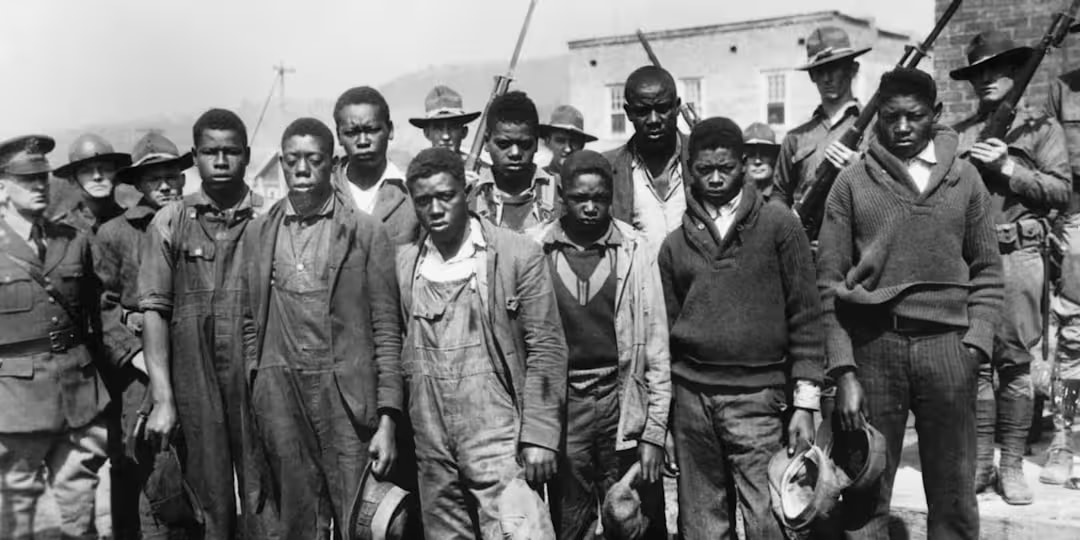
Why Scottsboro belongs in this story
Scholars Steven F. Lawson, David R. Colburn, and Darryl Paulson titled their 1986 Florida Historical Quarterly article Groveland: Florida's Little Scottsboro. The comparison names a pattern, not an equivalence. Scottsboro began in Alabama in 1931 and became a defining legal struggle involving the Scottsboro Boys. Groveland began in central Florida in 1949 with its own people, geography, evidence, official actors, and legal history.
Both cases centered on rape allegations against Black youths or men, drew national publicity, developed in racist legal environments, and prompted major defense and civil-rights organizing. Reading them together helps explain a recurring pattern of race, spectacle, and due-process failures. It does not make the cases interchangeable or decide the facts of either allegation.
The Four Men and Their Legal Outcomes
Ernest Thomas
Thomas faced the 1949 indictment but died on July 26 before authorities arrested or tried him. In 2021, the State Attorney emphasized that no conviction had ever displaced Thomas's presumption of innocence and asked the court to dismiss the outstanding indictment.
Samuel Shepherd
A jury convicted Shepherd and sentenced him to death. The United States Supreme Court reversed that conviction in 1951 and ordered a new trial. Sheriff Willis McCall shot and killed Shepherd later that year before the new trial occurred.
Walter Irvin
Irvin received a death sentence after the first trial. The Supreme Court reversed his conviction, but he survived McCall's 1951 shooting and faced another trial. A second jury convicted him and another death sentence followed. Florida later commuted the sentence to life, and Irvin gained parole in 1968.
Charles Greenlee
Greenlee was 16 when the state prosecuted him. The jury recommended mercy, and the court imposed a life sentence. He did not appeal that conviction and eventually gained parole in 1962. A judge vacated his conviction in 2021.
An accusation and a community under threat
Authorities arrested Shepherd, Irvin and Greenlee as the case spread through Lake County. Ernest Thomas remained at large. The Equal Justice Initiative reports that a crowd of at least one hundred white men gathered outside the Lake County jail and demanded access to the accused. When the crowd could not reach the prisoners, armed men entered Black neighborhoods around Groveland, fired into property and burned homes. EJI reports that hundreds of Black residents fled the area because they feared further violence.
Trial testimony, Florida Memory materials, PBS's archival project, and the supplied manuscript describe the same atmosphere of unrest. They document reports of an angry crowd outside the jail, attacks on Black neighborhoods, displacement after the accusation became public, and the intervention of the National Guard as officials attempted to control the violence. Those sources do not determine whether the underlying allegation was true or false by themselves, but they establish that the prosecution developed in a community experiencing severe racial tension and violence.
That distinction strengthens rather than weakens the historical account. A serious accusation required a serious investigation, and the accused men retained the same legal protections that criminal defendants receive regardless of public anger. The violence surrounding Groveland created conditions that later became relevant when courts and lawyers examined whether Shepherd and Irvin could receive a fair proceeding. In the State Attorney's 2021 motion, Gladson noted the extraordinary publicity surrounding the case and quoted Justice Robert Jackson's 1951 concurrence describing the circumstances as one of the worst threats to American justice.
Ernest Thomas dies before trial
Thomas escaped immediate arrest and remained the subject of a large search. On July 26, 1949, a group of white men located and killed him in Madison County. The Equal Justice Initiative reports that the mob found the 26-year-old beneath a tree and fired more than 400 rounds. Two days later, according to EJI, a coroner's jury characterized the killing as justifiable homicide.
The 2021 State Attorney motion establishes the legal consequence with less ambiguity. Thomas died before authorities could arrest or try him. Gladson wrote that Thomas therefore remained presumptively innocent because no trial had ever produced a conviction. The original indictment apparently remained unresolved in the court file for more than seventy years, so the prosecutor asked the court to dismiss it and restore the file to the legal position that Thomas had occupied when he died.
That point prevents the history from assigning Thomas a status the legal system never established. The grand jury accused him, but an indictment does not equal a conviction. No jury heard a complete case against Thomas, no defense attorney tested the evidence through a trial on his behalf, and no verdict established guilt. Any account of Groveland that describes Thomas as legally guilty therefore goes farther than the historical court record allows.
Place, work, and jurisdiction
Groveland began as Taylorville, a settlement established in 1895 in southern Lake County. The town took the name Groveland in 1922. Turpentine, lumber, and citrus work shaped its economy and its social geography. The Black community became central to the aftermath of the accusation because the violence and displacement that followed were directed into Black neighborhoods around Groveland.
The reported attack was near Okahumpka, not in the town of Groveland. The first court proceedings were in Tavares, the Lake County seat. That physical route matters. The allegation moved from a roadside report to a county investigation, a jail crisis, courtrooms in Tavares, prison custody at Raiford, and the later transport shooting. The prosecution's name attached the men to Groveland, but its consequences moved through several Florida jurisdictions.
What the men said happened in custody
Accounts collected after the arrests raised serious questions about the treatment of the defendants. Walter Irvin told NAACP representative Franklin Williams that officers had taken him and Shepherd to a wooded area and beaten them while attempting to obtain a confession. Williams later interviewed the prisoners and reported physical injuries, bruising and bloody clothing. Irvin's sworn account, NAACP materials, trial testimony, and the supplied manuscript preserve those statements. A defensible account must identify those descriptions as testimony and reported observations rather than convert every allegation into an independently adjudicated fact. The defendants said officers beat them, Williams reported seeing injuries, and EJI's historical account describes the men as having suffered police torture. The available sources therefore provide substantial evidence of mistreatment, but careful journalism should preserve the distinction between what witnesses reported and what a court separately found.
The allegations nonetheless form an important part of the case because they arose in connection with efforts to secure confessions. The defendants continued to deny responsibility. Their claims about police conduct also became part of a much larger body of concerns that later included undisclosed medical information, questions surrounding physical evidence and the way prosecutors presented evidence to jurors.
The medical examination the defense did not receive
One of the clearest findings in the 2021 motion concerns Dr. Geoffrey Binneveld, who examined Norma Padgett on July 16, 1949. According to the State Attorney's reconstruction of the FBI file, agents interviewed Binneveld on September 2. The doctor reported that he had found no spermatozoa during the examination and said that if someone asked him whether Padgett had been raped, he would answer that he did not know.
The State Attorney also reported that the defense did not receive those facts and that Binneveld did not testify at either trial. That omission does not independently establish what happened on the night Padgett described, and the absence of spermatozoa does not by itself prove that no sexual assault occurred. It does establish something narrower and legally important: information that could have assisted the defense existed in an FBI file, and the defense did not receive it. Gladson's office explicitly identified the material as exculpatory evidence that the prosecutor had withheld.
The distinction makes the historical claim stronger because it avoids treating medical evidence as more conclusive than it was. The examination did not give later investigators a definitive answer about the allegation. It did, however, produce information that jurors never heard and that defense attorneys could have used when challenging the state's case.
Physical evidence comes under renewed scrutiny
Deputy James Yates served as the state's principal law enforcement witness and introduced much of the physical evidence at the trials. According to the 2021 motion, that material included Walter Irvin's shoes, shoe casts, trousers, cotton fibers, a handkerchief and the gun found in Greenlee's possession. Defense attorneys challenged parts of that evidence during Irvin's second trial, including the quality and reliability of shoe impressions that purportedly connected him with the scene.
Defense expert H. V. Bennett testified that, in his opinion, no foot had occupied Irvin's shoe when someone made one of the impressions. Gladson's motion did not present that conclusion as an absolute fact. Instead, it acknowledged that investigators could no longer know with certainty how the impression had been created and then examined later allegations involving Yates in another Lake County prosecution. That later history gave the State Attorney additional reason to question the reliability of the earlier physical evidence without claiming that every disputed item in Groveland had been conclusively fabricated.
That cautious distinction matters. Later misconduct or accusations involving an investigator do not automatically prove misconduct in every earlier case. The State Attorney nevertheless considered the information significant enough to include in the motion because Yates had handled crucial evidence and because the defense had already questioned the shoe casts during Irvin's trial.
A test that investigators could still perform
Walter Irvin's trousers survived. In 2021, investigators photographed the preserved evidence and sent the trousers to the Florida Department of Law Enforcement crime laboratory in Orlando. On September 16, the laboratory reported that microscopy identified no semen on the item. Investigators sampled multiple areas, including the location that prosecutors had associated with a visible stain during the second trial.
The finding deserves the same evidentiary restraint as the medical examination. A test conducted decades later cannot reconstruct every circumstance surrounding the trousers, and the result alone does not establish every fact in dispute. The State Attorney nevertheless considered the result important because prosecutors had presented the stained trousers to Irvin's jury without obtaining available scientific testing at the time. The 2021 motion specifically relied on the FDLE result when asking the court to vacate Irvin's conviction.
What Later Review Established
No definitive medical conclusion
The examining doctor later told the FBI that he could not say whether rape had occurred. The defense did not receive that information.
Defense challenged shoe impressions
An expert disputed a shoe impression during Irvin's second trial. The State Attorney later reviewed additional concerns involving the deputy who handled the evidence.
No semen identified on Irvin's trousers
FDLE tested preserved evidence and reported that microscopy identified no semen on the trousers.
State sought to undo the remaining cases
The State Attorney relied on newly discovered evidence and the historical record when asking the court to vacate convictions and dismiss outstanding indictments.
Convictions and a Supreme Court reversal
A Lake County jury convicted Greenlee, Shepherd and Irvin in 1949. Greenlee received a life sentence after the jury recommended mercy. Shepherd and Irvin received death sentences and appealed. The United States Supreme Court reversed their convictions on April 9, 1951, and ordered new trials. The State Attorney's later review explained that the majority ruling involved discriminatory jury selection, while Justice Jackson separately emphasized the wider atmosphere surrounding the proceedings in his concurrence.
That distinction prevents a common historical error. The Supreme Court did not issue a finding that Shepherd and Irvin had proved their factual innocence. The Court invalidated their convictions and returned them to the position of defendants awaiting lawful adjudication. As Gladson later explained, the reversal restored Shepherd's presumption of innocence. The same principle applied to Irvin until the state tried him again.
Sheriff Willis V. McCall and official power
Willis V. McCall was Lake County sheriff during the arrests, the jail-mob crisis, and the prosecution that followed. His office sat at the center of the official response. It directed the search for the four men, held the three arrested defendants as the crowd gathered at the Lake County jail, and moved the prisoners out of immediate danger as violence spread through Black neighborhoods. That operational role is important because the case's public violence and its criminal process did not unfold separately.
In November 1951, after the Supreme Court reversal, McCall transported Shepherd and Irvin from Florida State Prison at Raiford toward Lake County. McCall shot both men during the trip, killing Shepherd and gravely wounding Irvin. McCall said the prisoners attempted to escape and attacked him while trying to obtain his weapon. Irvin survived and gave a sharply different account. In testimony preserved in the PBS project and the supplied manuscript, he said McCall stopped the vehicle before shooting the prisoners.
The historical record establishes the shooting, Shepherd's death, and Irvin's injuries. It does not permit the competing accounts of the moments before the gunfire to be treated as identical. A coroner's inquest accepted McCall's account, while Irvin's account, the FBI investigation, and later public scrutiny left the episode at the center of the case's history. McCall's later public record, including his continued tenure as sheriff and subsequent controversies documented in public reporting and archival collections, shows why historians continue to examine how official power shaped the case. It does not settle every disputed fact about the shooting.
The retrial process never reached Shepherd. The FBI expanded an already active investigation after the shooting. Irvin eventually returned to trial, and a jury convicted him again in February 1952. The court again imposed a death sentence. Florida commuted that sentence to life imprisonment in 1955, and Irvin gained parole in 1968. Greenlee gained parole in 1962.
The state returns to its own case
Public scrutiny of Groveland never completely disappeared. Florida lawmakers unanimously apologized to the Groveland Four in 2017. Attorney General Pam Bondi directed FDLE to conduct another review in December 2018, and Gov. Ron DeSantis granted pardons to the four men on January 11, 2019. FDLE later referred its investigation to State Attorney Gladson in July 2021.
One part of the FDLE finding deserves particular attention because it demonstrates why a careful article should not overstate what the modern investigation proved. According to Gladson's motion, FDLE concluded that its investigation had not developed new verifiable and substantial evidence that independently corroborated or contradicted the established accounts concerning the men's innocence or alleged participation. Gladson then conducted his own legal review of the surviving material, including evidence that had not received proper consideration during the original proceedings.
That review led the elected prosecutor for Lake County to ask the court to dismantle the remaining legal judgments. He sought dismissal of Thomas's unresolved 1949 indictment, dismissal of the later indictment against Shepherd, vacation of Greenlee's conviction and vacation of Irvin's conviction. Gladson argued that the evidence and history revealed a sweeping failure of due process.
On November 22, 2021, Lake County Circuit Court Administrative Judge Heidi Davis granted the motion. The State Attorney's Office now describes the Groveland Four convictions as wrongful and states that Gladson's work cleared the four men of wrongdoing 72 years after the case began.
Seventy-Two Years of Legal History
Four men charged
A Lake County grand jury indicts Charles Greenlee, Walter Irvin, Samuel Shepherd and Ernest Thomas.
Thomas killed
Thomas dies in Madison County before police arrest him and before any trial takes place.
Three convictions
A jury convicts Greenlee, Shepherd and Irvin. Greenlee receives life imprisonment, while Shepherd and Irvin receive death sentences.
Supreme Court reverses
The United States Supreme Court overturns the convictions of Shepherd and Irvin and orders new trials.
McCall shoots Shepherd and Irvin
Shepherd dies during transport from Raiford. Irvin survives and later faces another trial.
Irvin convicted again
A second jury convicts Irvin and the court again sentences him to death.
Florida grants pardons
Florida's Executive Clemency Board grants pardons to all four men.
Court grants the State's motion
The Lake County court vacates the remaining convictions and dismisses the outstanding indictments addressed in the State Attorney's motion.
What Groveland leaves behind
The final court action cannot change what happened between 1949 and 2021. Thomas died without a trial. Shepherd died after the Supreme Court had already erased his conviction and before Florida could retry him. Irvin survived the roadside shooting, endured another death sentence and remained imprisoned until his parole in 1968. Greenlee entered the prosecution at 16 and remained under a life sentence until his parole in 1962. The State Attorney's Office now recognizes the case as a wrongful prosecution, but that recognition arrived after every member of the Groveland Four had died.
The case also demonstrates why criminal justice reporting must preserve distinctions that public outrage can erase. An accusation does not equal proof. An indictment does not equal conviction. A conviction does not become immune from judicial review simply because a jury returned it. A reversal does not by itself prove factual innocence, but it does remove the conviction and restore the legal protections that existed before the defective judgment. Those distinctions governed the State Attorney's approach when he returned to court in 2021.
Groveland therefore remains a story about institutional responsibility as much as individual tragedy. The historical sources document racial violence surrounding the case, disputed accounts of police conduct, withheld exculpatory information, contested physical evidence, the killing of a defendant before trial, the shooting of two defendants after a Supreme Court reversal, and convictions that Florida ultimately vacated. None of those facts requires speculation about what individual officials secretly believed. The surviving record provides enough evidence on its own.
The strongest conclusion comes from the institution that once prosecuted the case. After reviewing the available history, the Fifth Judicial Circuit State Attorney's Office concluded that the four men had suffered a profound injustice and asked a court to correct the remaining legal record. Judge Heidi Davis granted that request. Seventy-two years after four names entered a Lake County indictment, Florida's own criminal justice system formally removed the remaining judgments and charges that had survived from the Groveland prosecutions.
Acknowledgment and Thanks
Carceral Collections gratefully acknowledges the work of the Office of the State Attorney for Florida's Fifth Judicial Circuit, whose 2021 review, motion and preservation of the legal history provide essential primary documentation for understanding the case; the Equal Justice Initiative, whose research preserves the history of racial violence surrounding Ernest Thomas and the Groveland Four; NBC News and the journalists who reported the 2021 court action for a national audience; and the Zinn Education Project, which has helped keep the history accessible to educators and the public. This article also draws upon earlier archival research using Florida State Archives materials, trial testimony, contemporary newspapers, NAACP records and correspondence surrounding the case. Carceral Collections recognizes that historical understanding depends on archivists, librarians, journalists, attorneys, researchers, public agencies, descendants and institutions that preserve records and make them available for continued examination. Their work allows later generations to examine difficult history against surviving evidence rather than memory alone.