I first heard about Mama Herc, K-Wing Slim, and Nigger Charlie when I was young, listening to older men talk about prison. Nobody handed me a complete story. A name would come up, somebody would laugh, and somebody else would have a worse version. I remembered the names long before I knew where to look for the people behind them.
Then there was the jar of gold teeth.
That one hardly needed telling. Officers at Lake Butler supposedly knocked gold teeth out of prisoners' mouths and kept them in a jar. You could picture it immediately. Depending on who was talking, somebody had seen it, somebody knew a man who had seen it, or everybody knew about it and you were a fool for asking. The jar was part of the warning about going up the road.
Years later, reading Charles Norman's account of knowing Mama Herc, I came across something the stories I heard had not prepared me for: Herc, nervous about having his photograph taken, with no money to pay for it. The man whose name could frighten a newcomer wanted a picture to take home. Norman paid the dollar fifty.
I keep coming back to that photograph. The man in it belongs to the same world as the jar, the feared officers, and the weight-pile stories. Yet he looks pleased to be standing there. Norman's account gives us a chance to spend some time with him before the next teller takes over.
01 / The StoryThe Jar At Lake Butler
The story places the jar at Lake Butler's Reception and Medical Center. A prisoner arriving with gold teeth could supposedly lose one to an officer who wanted another piece for the collection. That is the version that sticks: a beating followed by somebody keeping a souvenir. Some tellings attach feared officers' names to it. Others leave the officers unnamed and concentrate on the jar itself, as though its presence explained everything a newcomer needed to understand about the place.
The jar remains an unconfirmed legend. What survives is the story, and the uneasiness people remember carrying away from it.
One version, reposted online under the name sinceAtari, claims officers displayed a pickle jar full of teeth and bragged that they came from men who talked back. Other tellings describe a rumor passed among prisoners. The circulating account is linked here. The object stays much the same while the distance to it changes: right there in front of a man in one telling, always somewhere out of sight in another.
The jar is a particularly nasty detail because a tooth is so personal. You feel a missing one with your tongue. People see it when you speak. A gold tooth might have been something you paid for, something you liked about your face, something that still belonged to the life you had before prison. In the legend, an officer could take it and keep it. The injury was only part of the humiliation.
And the next man coming through the gate would hear about it.
That is how the threat could keep working without anyone producing the jar for every listener. A newcomer did not have to resolve the story before deciding to watch his mouth. He had to decide how much he was willing to risk finding out. I can understand why somebody would remember that warning decades later, even if he never saw a shelf, a room, or a single tooth.
02 / The StoryThe Stories Reached You First
Norman remembered hearing about Herc before meeting him. In Fighting the Ninja, he describes older prisoners passing along frightening stories about an immensely strong man who sexually coerced others. He treats those stories as prison lore; he was not claiming to have witnessed all the incidents people attached to Herc's name. His account is worth reading in full.
Anybody who has sat through that kind of conversation knows how difficult it can be to separate advice from performance. The speaker has been somewhere you have not been. He may genuinely want you to avoid trouble. He may also enjoy having a younger audience that cannot challenge him. A story can do both jobs. You listen because you might need the information, and because nobody wants to be the person who ignored the warning and found out the hard way.
What I remember is the confidence. The stories did not arrive with a lot of hesitation.
The jar, Herc, and the officers' nicknames gave that confidence something to rest on. Instead of a vague warning that prison was dangerous, you got a person to look for or an object you could imagine. By the time a man arrived, he could already be measuring strangers against descriptions he had heard in a county jail or back home. That is a heavy introduction to a place. You have not learned your way around, but other people's stories are already making some of your decisions for you.
Norman's first serious encounter with Herc is memorable partly because he managed to ignore all of that preparation. He picked an argument with the man without knowing who he was.
03 / The StoryA Bad Morning To Get Brave
It was about eight on a Saturday morning at Raiford. Norman's friends had brought prison wine to the weight pile: tomato-puree buck, carried in bleach jugs. He agreed to a drink. One cup became two. Soon the men were loud and laughing, while a solitary lifter nearby kept looking back at them.
Norman remembered a bar loaded with roughly six hundred pounds, bowing as the man lifted it. The lifter wore a headband and beads. He dropped the weights and stared at the group. Norman, drunk enough to take offense and not sensible enough to leave it alone, shouted at him.
"What you looking at?"
The man stepped toward him. Norman stepped forward too, threatening to break one leg and then the other. His friends had gone quiet. In Norman's telling, the lifter stopped, took several breaths, turned back to the weights, and hurled the loaded bar upward before throwing it down. Iron clanged against concrete. Then he left. Norman and his friends watched him go.
Only afterward did they tell him: that was Mama Herc.
Norman was still talking tough. By the next morning, the wine had supplied a less flattering opinion of the whole adventure. He remembered a punishing headache and called it his first and last experience with buck. The encounter appears in his memoir with the embarrassment left in; he had not recognized the man he was threatening and had no sober explanation for why threatening him had seemed sensible.
A week later, Murf the Surf brought them together in the chow hall. Murf did not know about the confrontation and began making an introduction. Herc recognized Norman immediately. Now Norman had to sit with the man whose workout he had interrupted and whose legs he had offered to break.
Herc told Murf that he had considered fighting him. But Norman had looked crazy enough to do what he was threatening, so Herc had decided to go back to his cell. It was an unexpected explanation from a man with his reputation. Norman admitted what had happened, blamed the buck, and apologized. Then he put his hand across the table.
Herc took it. Norman remembered his own hand disappearing inside the larger one and hoping Herc would let go.
"We straight," Herc said.
The apology does not get as much attention as the weights. It is the part I like best. Norman had made an ass of himself, Herc had decided the fight was not worth it, and a sober conversation finally gave them a way past the whole thing.
04 / The StoryA Dollar Fifty For The Picture
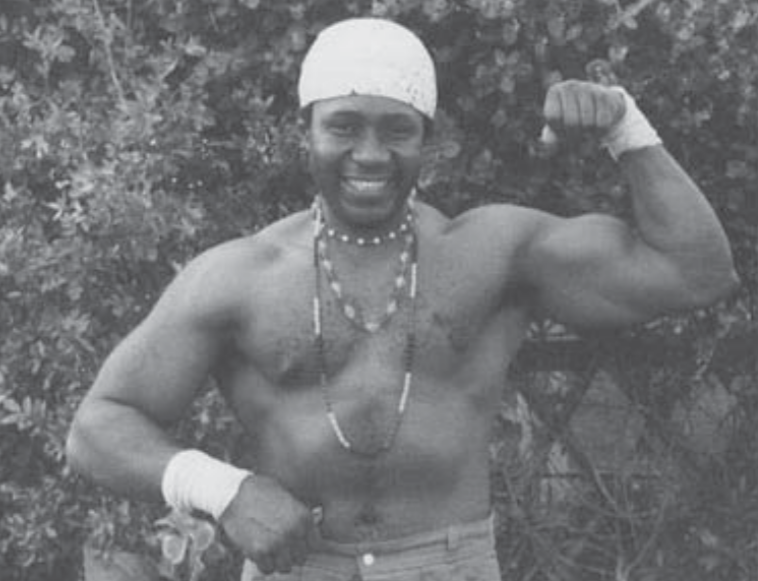
Charles Norman took the photograph in 1985 at Zephyrhills Correctional Institution, shortly before Herc's release. He explains the occasion in the note published with it. Norman ran the Jaycee Photo Project, taking 35 mm photographs on weekends. The price was $1.50 for two copies. When he suggested a portrait, Herc wanted one but said he had no money. Norman offered to pay, give Herc a copy, and keep the other so people would have a record of what he looked like.
That is how we have this image.
Norman remembered perhaps a hundred prisoners watching from outside the frame. Herc was nervous. According to the note, the last photograph taken of him had been the one at Lake Butler when he entered prison years earlier. Now he was about to leave, with an audience watching him try to settle into a pose. He adjusted his headwrap and beads, flexed his muscles, and Norman pressed the shutter. Norman remembered Herc being proud of the result. Looking at the photograph, that part is not hard to believe.
Spend a little time with the face. The arm gets your attention first, especially if you have already heard the stories. But Herc is smiling. He has made an effort to look the way he wants to be remembered. There is something familiar about that effort, even for a reader who has never been inside a prison. Most of us know the slight awkwardness of standing still while somebody takes our picture, deciding what to do with our hands, hoping the result will look like us on a good day.
Norman also gives us a body that had changed. When he first met Herc at Raiford in 1980, he estimated that Herc was about forty pounds heavier. Between then and the photograph, Herc spent eighteen months at Brooksville Road Prison, working long days on road crews. Norman put his later weight at around 240 pounds and still considered him incredibly strong. These are his estimates, but the account gives the photograph a setting the legends often leave out: years of work had worn the man down.
Herc did not have the dollar fifty. Norman did. Each got a copy.
I find that exchange more lasting than another argument about exactly how much Herc could lift. It gives us something small enough to trust to the people involved: one man wanted his picture, another thought it worth paying for, and a photograph survived. No reconstruction of the crowd is needed. The people outside the frame remain outside it. Herc is the one we get to see.
05 / The StoryK-Wing Slim And Nigger Charlie
The stories about K-Wing Slim and Nigger Charlie carried a different warning from the stories about Herc. Herc was a prisoner. These names appear in recollections of feared staff. That difference mattered to the person who might have to deal with them. An officer did not need to win a fair fight to have power over your day.
C. Michael Lambrix remembers K-Wing Slim and Breezeway Red as feared guards associated with Lake Butler's K-Wing in To Live and Die on Death Row. Their names appear on page 101, part of the reputation he recalls surrounding that place.
Nigger Charlie appears by that historical nickname in a letter signed BAMA, published in Florida Prison Legal Perspectives in 2002. Recalling staff brutality, BAMA places him alongside Slim, Breezeway Red, and Shithouse Shorty. The letter is on page 19. It reads like a roll call of names the writer expected other prisoners to recognize.
A nickname can outlive almost everything else a listener knew about somebody. You may forget a first name you barely heard, or never learn it at all. You are less likely to forget the name used when another man tells you to be careful. Years later, two people can recognize it immediately and still disagree about dates, assignments, or which officer did what. Some tellings use Ninja Charlie or another spelling, which adds another difficulty when trying to follow the person through the stories.
In the folklore, the jar becomes part of that reputation. Sometimes a feared name gets attached to it; sometimes the officers remain unnamed. No account cited here establishes that Slim or Nigger Charlie kept it. But in the telling, the jar and the names belong to the same warning about what could happen at Lake Butler.
What interests me is how much the names could do before their owners appeared. A prisoner hearing that a particular officer was on a wing might already be bracing himself. Then a story about a jar would give him one more reason to stay quiet. The ordinary authority of the uniform and the extraordinary cruelty of the tale could reinforce each other. To the man listening, the question was less about finding the perfect version of the story than about getting through whatever came next.
Breezeway Red and Shithouse Shorty linger at the edges of these accounts. Their names survive more clearly than the individual encounters behind them. There is dark humor in the nicknames, but little comfort in the company BAMA gives them.
06 / The StoryWhat Herc Told Norman
As Norman got to know Herc, he heard a story that went much further back than the weight pile. Herc described being abused by older boys at a state reform school and becoming determined to build a body strong enough to defend himself. This is Herc's recollection as Norman records it. It is also a painful thing to set beside the stories other prisoners told about him.
The muscle had not always been there.
Norman's portrait is uncomfortable because it does not settle into one easy account. He describes a man surrounded by allegations of predatory behavior, but he also reports Herc denying the lurid stories about attacking new arrivals. Herc's account of being abused as a child neither proves nor excuses later wrongdoing. It does, however, belong to what he told a man who knew him. Leaving it out would give readers a cleaner villain and a poorer sense of the person.
The stories about Herc also mixed fear of sexual violence with mockery of how he looked and behaved. Those were not the same thing. His beads, his manner, and his relationships could all become material for a storyteller, even though none of them established that he had assaulted anyone. Norman remembers both the accusations surrounding Herc and Herc's denial of the worst newcomer stories.
By then, Norman knew him well enough to have something besides the warning to remember. They had argued, shaken hands, and talked. Herc could still be an imposing presence, but he was no longer just the enormous stranger at the weights.
07 / The StoryThe Ending Depends On Who Tells It
Norman identifies Herc as Alphonia Smith and remembers him leaving prison for St. Petersburg after the photograph. Later, the prison grapevine brought word that he had been killed within roughly a year of release. That was the news Norman heard, not a death he witnessed.
Online, Herc gets a different ending.
A circulating TikTok version places an alleged revenge killing at the weights. It also changes Murf's role in a confrontation and offers another explanation for the photograph's framing. The clips repeat much of the same narration; they are another version traveling, rather than separate witnesses agreeing. That telling is linked here.
One ending sends him through the gate and back to St. Petersburg. The other leaves him at the weights. They cannot both be right. Norman's account places him outside prison, but the later report of his death remains hearsay. The uncertainty has left room for the more dramatic ending to keep circulating.
I can see why the weight-pile ending would hold an audience. It brings the story back to the place associated with Herc's strength and gives somebody the revenge a listener might feel is due. It lands. An uncertain report about what happened after release does not land in the same way. But a satisfying ending is a reason a story might spread, not a reason to believe that it happened.
The jar has that advantage too. It makes a whole frightening place fit inside one ugly image. You do not need much setup, and the audience is unlikely to forget it. Once a story has something that strong at its center, a detail that interrupts it can feel like an inconvenience. The photograph interrupts the Herc story in a useful way. It leaves us with a man expecting to go home, whatever somebody later said about how he died.
08 / The StoryThere Was Plenty To Be Afraid Of
The prison stories had plenty of real fear to draw on. In the federal case LaMarca v. Turner, prisoners at Glades Correctional Institution described assaults and failures to protect them. Glades was not Lake Butler, and the case does not establish the jar story. It does offer a documented glimpse of dangers prisoners faced beyond the folklore. The case and appeal are linked here.
A man did not have to see a jar of teeth to carry the warning around with him. He could remember who told him, the place he was headed, and the feeling that he had better not find out whether it was true. For the person hearing it, there was nothing especially entertaining about that possibility.
Years later, the same story might get a laugh. The delivery changes when a man is home, talking to people who never knew him inside. A laugh can mean recognition, relief, disbelief, or simply that the teller knows how to hold a room. I would not assume it means the experience was easy. Some of the roughest stories are told by people who have had years to find a way to tell them at all.
09 / The StoryNorman Stayed With Him
One of the strongest scenes in Norman's memoir has no showdown. Herc is frightened about HIV and wants an answer Norman cannot give him. Eventually he cries on Norman's shoulder. The man whose strength occupies so much of the prison folklore is afraid, and another man stands there with him.
There is no diagnosis to extract from that scene. Some medical fears circulating in the account were mistaken: HIV is not spread by ordinary casual contact or environmental surfaces, and appearance does not establish someone's status. The health information is linked here.
What stays with me is Norman's willingness to include the encounter. Crying in a hallway does not fit the part Herc usually gets assigned in these stories. It would be easy to lose that scene in a retelling built around how much weight he could move or how badly other men feared him. Yet it belongs to Norman's experience of knowing him as much as the confrontation does. Herc wanted reassurance. His strength could not give it to him.
The photograph carries something of that same difficulty for the legend. A man can be proud of his body, nervous before a camera, feared by others, and frightened himself. None of those moments wipes the others away. Norman did not meet Herc once, get his best story, and disappear. He knew him across enough situations to leave us with a person who was harder to reduce to a single episode.
I am glad he took the picture.
10 / The StoryThe Stories Keep Traveling
The names now turn up in videos watched far beyond Florida. Someone who has never been inside can hear a Mama Herc story for the first time beside a comment from a man who remembers hearing it decades ago. The conversation picks up again, with all the interruptions, disagreements, and competing versions that used to happen in a much smaller circle.
The videos below offer other tellings about Mama Herc, K-Wing Slim, and Nigger Charlie. They belong to that continuing conversation, with its disagreements and changes of detail.
There is no reason to expect everyone who did time to remember the same prison culture, either. Institutions, years, housing, and the people around you make a difference. In a 2026 Prison Writers essay, Orion Flowers describes pressures surrounding LGBTQ life and gang expectations from his own experience. His account is a personal perspective, not a statewide survey. It is another voice worth hearing, particularly beside older stories that can make a whole prison system sound as though it never changed.
Going back through these accounts, I found details I had never heard when I was young. Nobody had told me about the dollar fifty, or Herc being nervous before the camera. I knew the kind of story people told about his strength. I had not heard about Norman offering an apology, or about the day Herc cried. Those moments stayed with me after the more familiar stories had brought me back.
11 / The StoryThe Picture He Took Home
The jar of gold teeth is still out of reach. It survives in accounts that disagree about whether someone saw it or only heard about it, and its physical existence remains unsettled here. K-Wing Slim and Nigger Charlie survive in the names prisoners remembered and repeated. Mama Herc survives in those conversations too, along with conflicting accounts of what happened to him.
But we also have the photograph.
Herc stood in front of Norman's camera, adjusted himself, and flexed. Other prisoners watched from beyond the frame. Norman paid for two copies, kept one, and gave the other to Herc. Whatever happened after release, that small arrangement had already been made. For once, the man whose reputation usually arrived before him had a chance to decide how he wanted to look.
That is where I want to leave him: pleased with his picture, about to go home.
If you remember a direct encounter, share the place, approximate year, and what you saw or heard in the comments below.
In Their Own Telling
More Voices, More Stories
These videos offer another way into the stories. Choose a video to load its player, or watch on YouTube.
Mama Herc, Florida Prison Legend

End Of Sentence | 18:27. The Mama Herc legend, told in another voice.
Watch On YouTube ↗K-Wing Slim And Nigger Charlie: Another Telling

End Of Sentence | 13:56. Another telling of the names and warnings that traveled through Florida prisons.
Watch On YouTube ↗Your Turn
The Conversation Continues
Sign in to join the public conversation. Comments appear after moderation.
Sign In To CommentWhere The Stories Come From
- Charles Norman: Fighting The Ninja ↗
Journal of Prisoners on Prisons 19(1), 2010, pp. 35-48. Norman recounts knowing Herc; the photograph and its story appear on page 47.
- C. Michael Lambrix: To Live And Die On Death Row ↗
Page 101 recalls the reputations of K-Wing Slim and Breezeway Red.
- BAMA Letter: Florida Prison Legal Perspectives ↗
September-October 2002, page 19. A prisoner's recollection of feared staff nicknames.
- The Circulating Pickle-Jar Account ↗
A circulating, unverified account attributed to sinceAtari.
- Mama Herc: The Circulating Video Version ↗
Compare the 2022 clip with the later retelling. The reported death differs from Norman's account.
- LaMarca V. Turner: District Court And Appeal ↗
Glades Correctional Institution litigation, 662 F.Supp.647 (1987). The 1993 appeal vacated the damages awards and part of the injunction and sent the case back for further proceedings.
- HIV Transmission: NIH And CDC ↗
A plain-language explanation of HIV transmission.
- Orion Flowers: LGBTQ+ Lives On The Line ↗
Prison Writers, January 21, 2026. Flowers's personal perspective on LGBTQ life and prison culture.