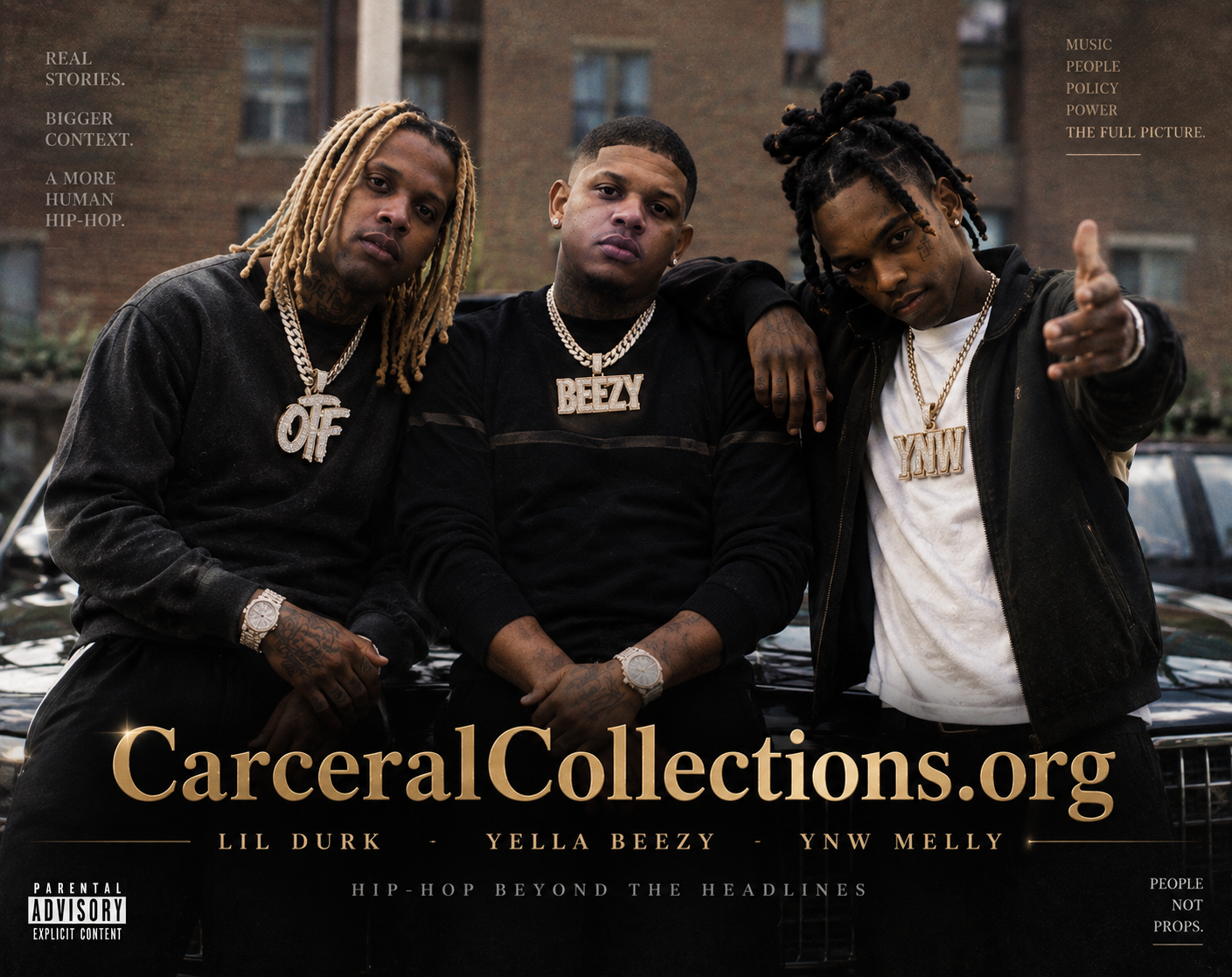
Hip-hop has always asked listeners to believe something. Sometimes that belief concerned the skill of the rapper, sometimes the poverty of the neighborhood, sometimes the danger surrounding the artist, and sometimes the emotional truth behind a story that may not have happened exactly as it was told. The genre developed its power by turning lived experience, exaggeration, humor, grief, fantasy, autobiography, and community memory into music that sounded more honest than most institutions ever did. That long tradition helps explain why the current relationship between rap and the criminal justice system feels so unsettling, because courts increasingly treat the same cultural material that fans recognize as layered storytelling as evidence capable of establishing motive, association, identity, or intent.
The recent cases involving Lil Durk, Yella Beezy, Mo3, and YNW Melly reveal how dramatically that relationship has changed. These prosecutions are not identical, and it would be irresponsible to force them into one narrative, but together they show how contemporary hip-hop now exists inside an environment of almost permanent documentation. News organizations followed the Durk prosecution through witness testimony, disputes over interviews and lyrics, closing arguments, jury questions, and his eventual acquittal, while the Dallas reporting surrounding Mo3’s death has documented allegations against Yella Beezy, evidentiary fights over music, and the separate conviction of Kewon White. The extensive coverage of YNW Melly’s first trial adds cellphone analysis, forensic reconstruction, gang evidence, social media, disputed messages, expert testimony, and a mistrial to the same larger picture.
What emerges from this body of reporting is bigger than celebrity crime. Hip-hop has become one of the most valuable cultural industries in the world while simultaneously producing an enormous digital archive of itself, and those two developments have created consequences that the culture is still learning to understand. Artists are encouraged to remain visible, accessible, authentic, provocative, and constantly connected to audiences, yet every additional layer of visibility creates another potential source of evidence if violence occurs around them. The modern rapper therefore occupies a strange position in which the same public authenticity that can increase streams and strengthen a career may later become something prosecutors, defense attorneys, journalists, fans, and jurors fight over in court.
Lil Durk and the Difference Between Allegation and Proof
The 2026 federal trial of Lil Durk demonstrates how easily a criminal accusation can become accepted as cultural truth before a jury ever reaches a verdict. Prosecutors alleged that Durk, whose legal name is Durk Banks, helped orchestrate a retaliatory murder-for-hire plot targeting rapper Quando Rondo after the 2020 death of Durk’s friend King Von. The 2022 Los Angeles attack killed Rondo’s cousin Saviay’a Robinson, and the government attempted to connect Durk to the plot through testimony from associates, alleged communications, evidence surrounding OTF, and limited use of his music. After a heavily covered trial, however, a federal jury acquitted Durk of the murder-for-hire charges, even though he remains in custody awaiting a separate racketeering prosecution.
That verdict matters because much of online hip-hop culture had already conducted its own trial long before the jury finished deliberating. Every testimony clip invited instant conclusions, every witness became the subject of livestream analysis, and every allegation could be converted into a thumbnail announcing that somebody had finally been “exposed.” This process creates an informal second courtroom where the rules are completely different from the legal courtroom, because hearsay can become content, partial testimony can circulate without cross-examination, and confidence is often rewarded more than accuracy. The legal system certainly has its own serious flaws, but at least the courtroom requires prosecutors to prove criminal responsibility under established evidentiary rules rather than merely assemble the most persuasive viral narrative.
Durk’s acquittal also exposes the danger of confusing proximity with criminal responsibility. A famous rapper may know people accused of crimes, employ people who later become defendants, reference dead friends in songs, or belong to a social circle that prosecutors describe as criminal, but none of those facts alone proves that the artist ordered a killing. Prosecutors in Durk’s case relied heavily on testimony from associates who had themselves faced criminal exposure, while his defense argued that those witnesses had incentives to cooperate and that others acted without Durk’s authorization. Pitchfork reported that the federal case was built largely around testimony from former associates who had pleaded guilty, making credibility and motive central questions for the jury.
The public discussion surrounding cooperation reveals another weakness in hip-hop commentary. The word “snitch” is regularly applied to plea agreements, proffers, witness testimony, compelled appearances, immunity arrangements, police interviews, and rumors as though these were all the same legal act. They are not, and pretending otherwise may produce entertaining arguments while making the public less capable of understanding how criminal cases actually work. A witness who testifies hoping for sentencing consideration presents obvious credibility questions, but those questions are supposed to be tested through cross-examination and corroborating evidence rather than resolved automatically by street vocabulary.
Hip-hop’s suspicion of informants did not appear from nowhere, and any serious discussion has to recognize that history. Black communities have experienced discriminatory policing, coerced statements, unreliable informants, aggressive surveillance, wrongful convictions, and government programs that treated political or cultural organizations as criminal threats. Those experiences help explain why cooperation with police can carry a meaning far beyond ordinary witness testimony. At the same time, an absolute code of silence can create its own injustice when families who lose children, siblings, or parents are expected to accept permanent uncertainty because speaking to investigators violates somebody else’s interpretation of loyalty.
That contradiction deserves more attention than it receives. A culture can legitimately distrust state power while still recognizing that victims and their families have rights, including the right to seek answers when someone is killed. Hip-hop commentary sometimes treats those two principles as mutually exclusive because conflict generates cleaner content than complexity does. The harder position, and probably the more mature one, is to scrutinize prosecutors aggressively while also refusing to romanticize silence when that silence protects people who may have committed serious violence.
Yella Beezy, Mo3, and the Legal Battle Over Rap Lyrics
The prosecution surrounding the death of Dallas rapper Mo3 pushes the debate into even more difficult territory. Mo3, whose legal name was Melvin Noble, was killed on Interstate 35E in Dallas in November 2020, and prosecutors later accused Kewon White of carrying out the shooting as part of an alleged murder-for-hire arrangement. A Dallas jury convicted White of capital murder in September 2026 and sentenced him to life without parole, while prosecutors continue to allege that rapper Yella Beezy, legally Markies Conway, hired him. Conway has pleaded not guilty and denied involvement, meaning White’s conviction cannot fairly be treated as a conviction of Beezy before Beezy’s own case is adjudicated.
The distinction may seem obvious, but it is exactly the kind of distinction that gets lost once a case becomes entertainment. A prosecutor can allege that one defendant acted at the direction of another, but the conviction of the first defendant does not eliminate the state’s obligation to prove the second defendant’s role independently. Recent reporting showed that Beezy’s lawyers were seeking additional time before his capital murder trial so they could obtain transcripts from White’s trial and prepare to cross-examine overlapping witnesses. That procedural reality is less exciting than declaring the entire case solved, yet it is essential if reporting is supposed to distinguish established facts from allegations.
The more culturally significant dispute concerns lyrics. Judges in the Mo3 litigation spent substantial time deciding whether jurors could hear songs by Mo3 and Yella Beezy that prosecutors said helped explain the alleged rivalry and motive. NBC 5 reported that most of the songs proposed by prosecutors were excluded, although the judge allowed selected lyrical material to be presented. The careful sorting itself reveals the difficulty of the issue, because courts must determine when artistic material has enough connection to alleged criminal conduct to become relevant without turning an entire musical genre into presumptive autobiography.
Hip-hop deserves special caution here because authenticity has been commercially weaponized for decades. Artists are often rewarded when audiences believe the danger, money, affiliations, rivalries, and violence described in songs are real, while labels and media outlets frequently market that perceived authenticity as part of the product. Once a criminal prosecution begins, however, the defense may reasonably insist that a song is artistic expression rather than confession. Those two positions can appear contradictory, but the contradiction belongs partly to an industry that has spent years making the border between art and biography intentionally difficult to locate.
That does not mean prosecutors should be free to treat lyrics as admissions whenever convenient. Fictional storytelling has always borrowed details from real life, and first-person narration does not automatically transform imagination into sworn testimony. Rap also uses exaggeration, metaphor, competitive boasting, invented scenarios, coded references, composite characters, and theatrical aggression in ways that are obvious to experienced listeners but may sound literal to jurors who do not understand the form. A court that ignores those conventions risks doing something it would rarely do to crime novels, horror films, or gangster cinema: assume that artistic realism proves personal criminal conduct.
At the same time, hip-hop cannot solve this problem by insisting that every lyric is fictional whenever police become interested. Some artists deliberately advertise their music as documentary truth, reference recognizable events, name real rivals, discuss identifiable locations, and blur the boundary between performance and personal history because that ambiguity increases credibility. The intellectually serious position is therefore neither “lyrics are confessions” nor “lyrics are meaningless fiction.” Courts should require a close factual connection between the specific expression and the alleged conduct while journalists should explain that connection rather than presenting a provocative lyric as though it solves the case by itself.
YNW Melly and the Rise of the Digital Criminal Case
The YNW Melly prosecution shows why the lyric debate may eventually become secondary to a much larger development: digital evidence. Jamell Demons was charged with murdering Christopher “YNW Juvy” Thomas Jr. and Anthony “YNW Sakchaser” Williams after prosecutors alleged the men were shot inside a Jeep and the scene was later presented as a drive-by shooting. During the 2023 trial, prosecutors introduced surveillance footage, cellphone information, forensic evidence, messages, testimony about gang affiliation, blood evidence, medical examination findings, and shooting reconstruction in an effort to establish who was in the vehicle and what occurred. The defense attacked the investigation as incomplete and challenged the state’s reconstruction of events, and after weeks of testimony the jury could not reach a unanimous verdict, resulting in a mistrial.
The cellphone evidence illustrates how different criminal investigation has become from the era that produced much of hip-hop’s mythology. An FBI expert testified about mobile phone data that prosecutors hoped would help establish the movements of a device they connected to Melly, while acknowledging limitations in how precisely such data can locate a person. Investigators also examined messages, surveillance footage, and other digital material while the defense questioned whether a device attributed to one person might have been used by others. The central legal problem therefore involved not only what the technology recorded but whether prosecutors could reliably connect that information to a particular human being at a particular time.
This is where the future of hip-hop criminal cases may actually be headed. Lyrics receive the headlines because they raise obvious First Amendment and cultural questions, but phones, location services, cloud accounts, security cameras, vehicle data, social media metadata, financial transfers, and digital communications can produce far more detailed reconstructions of human movement. An artist does not need to confess in a verse if prosecutors believe a network of devices can establish who traveled together, who communicated, who paid whom, and where everyone was when an event occurred. The modern street does not merely have witnesses standing on corners because the street itself has become surrounded by sensors.
That reality creates a problem for a culture built around constant visibility. Artists are expected to post frequently, interact with audiences, livestream, maintain social accounts, appear in other people’s videos, promote locations, preview music, respond to rivals, and document success in real time. These activities are good for branding because silence disappears quickly in an algorithmic marketplace. They are also capable of producing years of searchable information that investigators may eventually interpret in ways the artist never anticipated.
The Melly trial also demonstrated how readily a criminal proceeding can become part of an artist’s commercial story. Local 10 reported during the trial that Melly’s Spotify audience had grown beyond twelve million monthly listeners, even as jurors were considering evidence in a double-murder prosecution. That fact does not prove audiences support violence, but it reveals the strange economic logic surrounding celebrity prosecution, where legal jeopardy can increase curiosity, curiosity can increase streams, and tragedy can become inseparable from promotion even if nobody formally planned it that way.
When Tragedy Becomes Content
The commercial structure surrounding these cases deserves more criticism than individual rappers usually receive. Every arrest produces traffic, every courtroom appearance produces clips, every witness produces discussion, and every death creates an archive of older songs that listeners revisit looking for clues. Record labels can benefit from increased attention, platforms can benefit from increased engagement, bloggers can benefit from advertisements, streamers can benefit from donations and subscriptions, and fans can receive endless entertainment from events that destroyed actual families. The disturbing part is that no single person needs to coordinate this process because the digital marketplace rewards attention automatically.
This helps explain why violent rap stories often feel strangely immortal. A person can die once in the physical world while the footage, photographs, songs, testimony, rumors, and alleged final moments continue circulating indefinitely online. The reporting surrounding Mo3’s killing, for example, has repeatedly returned to surveillance footage, the highway shooting, alleged rivalries, rap videos, phone records, and courtroom testimony as the prosecution develops. During White’s trial, jurors were shown music videos involving Mo3 and Yella Beezy as prosecutors attempted to explain what they characterized as a longstanding feud.
There is legitimate public interest in that evidence, but there is also a moral difference between informing an audience and repeatedly selling somebody’s death back to them. Hip-hop media has criticized mainstream journalism for sensationalizing Black violence, often with good reason, yet independent hip-hop outlets and streamers can reproduce the same practice in a different visual language. Cable television may use ominous narration while a YouTube channel uses a shocked face, red circles, and the word “EXPOSED,” but both can reduce a dead human being to a device for keeping viewers from clicking away.
That critique should include audiences as well. Platforms respond to what people watch, share, comment on, and replay, meaning the market for violent content cannot be blamed entirely on executives or journalists. Fans frequently insist that they dislike exploitation while spending hours consuming increasingly detailed reconstructions of murders involving artists they claim to respect. Hip-hop’s uncomfortable truth is that tragedy has become one of its most reliable forms of engagement, and the industry will struggle to change that pattern until audiences stop rewarding death more consistently than they reward creativity.
The New Hip-Hop Journalist Is Also Part of the Evidence Environment
The role of the interviewer has changed along with the technology. A rapper once gave an interview largely for promotion, but today the interview can remain searchable for years and may later be reviewed by detectives, attorneys, journalists, rival artists, or prosecutors. The Durk litigation included disputes over material from a DJ Akademiks interview, which illustrates how hip-hop media can unintentionally become part of the evidentiary environment surrounding an artist. The interviewer may believe a conversation is about culture, while a lawyer listening years later may hear evidence of knowledge, motive, association, chronology, or contradiction.
This development places new responsibilities on hip-hop journalism without requiring journalists to become extensions of law enforcement. Reporters should still ask difficult questions, but they should understand that sensational prompts designed to make artists discuss open cases or identify neighborhood participants may have consequences beyond clicks. An interviewer who pressures someone into discussing a homicide and then celebrates the resulting viral moment cannot pretend that the media is merely observing events from outside. The microphone itself has become part of the environment in which those events are documented.
The same standard should apply when journalists report on defendants. Using the words “alleged,” “charged,” “convicted,” “acquitted,” and “mistrial” correctly is not boring legal caution because each word describes a fundamentally different status. Lil Durk was acquitted in one federal prosecution but still faces another case, Yella Beezy has pleaded not guilty while prosecutors continue to allege his involvement in Mo3’s death, Kewon White has actually been convicted, and YNW Melly’s first trial ended without a unanimous verdict. Treating those outcomes as interchangeable would turn reporting into fan fiction with legal terminology attached.
Is Hip-Hop Being Targeted, or Is Hip-Hop Documenting Itself Too Well?
The most controversial question may be whether prosecutors are uniquely targeting hip-hop or whether contemporary rap has made itself unusually easy to investigate. Evidence exists for concern about unequal treatment because prosecutors have repeatedly tried to use rap lyrics, gang imagery, neighborhood affiliation, and artistic identity in criminal proceedings in ways that can reinforce racial stereotypes. A largely Black musical form should not receive less artistic freedom than films, novels, heavy metal, country music, or crime television. The history of American policing gives communities every reason to question whether cultural difference is being interpreted as criminality.
Yet cultural bias cannot explain everything visible in these cases. Investigators are also working with surveillance recordings, cooperating witnesses, financial records, cellphone data, forensic reconstruction, social media histories, and communications that have nothing inherently musical about them. The YNW Melly trial, for example, involved detailed testimony about shooting trajectories, medical evidence, messages, and phone information rather than resting on his catalog. Local 10’s courtroom coverage repeatedly documented those technical disputes, including challenges to the state’s reconstruction and the defense argument that the investigation forced jurors to speculate.
Both realities can exist together. Prosecutors may sometimes overinterpret rap culture while also possessing legitimate non-lyrical evidence that deserves to be evaluated. Hip-hop advocates weaken their argument when they dismiss every prosecution as cultural persecution without examining the actual evidence, just as prosecutors weaken public trust when they present artistic expression as inherently suspicious. A serious culture should be capable of defending artistic freedom while still demanding accountability when reliable evidence establishes actual crimes.
The Industry Cannot Keep Selling Trauma as Authenticity
Record companies also deserve scrutiny because the modern industry often wants authenticity without responsibility. A young artist may be rewarded for remaining connected to dangerous local conflicts because those connections strengthen his image, while executives can later distance themselves if those same conflicts produce indictments or deaths. Violence can be marketed indirectly through aesthetics, interviews, playlists, visual branding, and promotional narratives without anyone openly saying that violence is the product. The result is a system in which danger can increase market value while the consequences remain concentrated among artists, families, and neighborhoods.
This does not mean labels cause every conflict or that rappers lack individual agency. Artists make decisions, rivalries often predate contracts, and neighborhood violence cannot be reduced to a marketing strategy invented in a corporate office. Still, the industry has learned how to monetize proximity to danger, and it should not be surprised when young artists internalize the lesson that credibility requires them to maintain relationships and behaviors that conflict with long-term safety. A business that profits from “realness” has an obligation to ask what kind of reality it is encouraging people to preserve.
Fans should ask the same question about their own expectations. Listeners often criticize rappers for becoming “Hollywood,” leaving their neighborhoods, changing friends, hiring professional security, or abandoning a street identity after becoming successful. Those complaints sound absurd once the same audience begins mourning another murdered artist and asking why he was still exposed to the conditions he had supposedly escaped. Perhaps one of the healthiest developments hip-hop could embrace is the idea that leaving danger behind is not betrayal but evidence that success actually worked.
Where Hip-Hop Goes From Here
The current state of hip-hop cannot be reduced to violence, courtrooms, or criminal cases because the culture remains enormous, inventive, funny, regional, experimental, political, commercial, and deeply human. The danger is that violent cases increasingly dominate public attention precisely because they combine celebrity, tragedy, mystery, and legal drama in a form perfectly suited to the algorithm. When murder cases routinely outperform discussions about production, songwriting, local scenes, independent business, or artistic innovation, the public begins receiving a distorted picture of what the culture actually contains. Hip-hop may then find itself trapped inside the very caricature it once fought against.
The better response is neither censorship nor denial. Journalists should investigate these cases rigorously, artists should retain the freedom to create disturbing and provocative music, courts should distinguish artistic expression from reliable evidence, and audiences should learn the difference between an allegation and an adjudicated fact. Hip-hop media should also devote as much intelligence to explaining legal procedure as it devotes to identifying supposed snitches, deciphering diss records, and reconstructing street rivalries. That kind of reporting would not make the culture less exciting because understanding what actually happened is more interesting than repeating what everybody already believes.
Nova’s position is therefore deliberately uncomfortable. Hip-hop deserves protection from lazy prosecutors, culturally ignorant juries, sensationalist reporters, exploitative labels, and outsiders who have spent decades treating Black expression as evidence of pathology. It also deserves protection from people inside the culture who profit from unresolved murders, romanticize retaliation, convert every witness into a traitor, and treat dead artists as endlessly renewable content. Loving hip-hop should mean defending its humanity strongly enough to criticize the machinery that profits when that humanity is destroyed.
The cases of Durk, Yella Beezy, Mo3, and Melly ultimately raise the same question from different directions: what happens when a culture that built its authority around being real enters an age in which reality is continuously recorded? The answer cannot be that artists should stop telling difficult stories, because difficult stories created hip-hop in the first place. The challenge is learning how to preserve truth, imagination, accountability, artistic freedom, and due process inside an environment where every phone can become a witness and every tragedy can become a revenue stream.
Sources and Further Reading
This essay draws from courtroom reporting, local journalism, national wire services, and hip-hop media. Allegations against defendants who have not been convicted are presented strictly as allegations rather than established legal facts.
⚖️ Case 1: Lil Durk (U.S. District Court & Los Angeles Trial)
- Associated Press. “Rapper Lil Durk Acquitted of Murder-for-Hire at Los Angeles Trial.” September 11, 2026. Read Report ↗
- CBS Chicago. “Chicago Rapper Lil Durk Acquitted in Los Angeles Murder-for-Hire Plot.” September 11, 2026. Read Report ↗
- Complex. “Keith ‘Flacka’ Jones Takes the Stand as Second Witness Against Lil Durk.” August 31, 2026. Read Report ↗
- Complex. “Legal Teams Duel in Lil Durk’s Murder-for-Hire Trial Closing Arguments.” September 9, 2026. Read Report ↗
- Complex. “Lil Durk’s Lawyers Push for Jury to Watch More of Akademiks Interview.” September 9, 2026. Read Report ↗
- Complex. “Lil Durk’s Murder-for-Hire Trial: Rapper Found Not Guilty on All Counts.” September 12, 2026. Read Report ↗
- Complex. “OTF Jam Denies ‘Hoping’ That Lil Durk Gets Life Sentence in Murder-for-Hire Trial.” August 28, 2026. Read Report ↗
- Complex. “OTF Jam Says He Feels ‘Bad’ for Testifying Against Lil Durk.” August 27, 2026. Read Report ↗
- Pitchfork. “Lil Durk Acquitted in Murder-for-Hire Trial.” September 11, 2026. Read Report ↗
- Reuters. “Grammy-Winning Rapper Lil Durk Acquitted in Murder-for-Hire Trial.” September 12, 2026. Read Report ↗
- The Guardian. “US Rapper Lil Durk Found Not Guilty of Murder-for-Hire Scheme.” September 11, 2026. Read Report ↗
- UPI. “Grammy-Winning Rapper Lil Durk Acquitted in Murder-for-Hire Trial.” September 11, 2026. Read Report ↗
- XXL. “Evidence in Lil Durk’s Murder-for-Hire Trial: DJ Akademiks Interviews, Music Videos, 911 Call, Texts and More.” August 19, 2026. Read Report ↗
- XXL. “Lil Durk’s Murder-for-Hire Trial: Charges, Evidence and What to Expect.” August 19, 2026. Read Report ↗
- XXL. “OTF Jam Identifies Lil Durk in Court as a Participant in Murder of Quando Rondo’s Cousin.” August 26, 2026. Read Report ↗
- Complex. “Lil Durk Not Guilty Verdict in Murder-for-Hire Trial: Second Trial Racketeering Court Date Set.” September 13, 2026. Read Report ↗
- Complex. “Lil Durk Jury Notes: What Did They Say During Deliberations?” September 10, 2026. Read Report ↗
- Complex. “Lil Durk Murder-for-Hire Trial: Pinkerton Liability and Legal Strategy.” September 8, 2026. Read Report ↗
- Complex. “Lil Durk Murder-for-Hire Trial: Opening Statements and Government Allegations.” August 21, 2026. Read Report ↗
- XXL. “Lil Durk Murder-for-Hire Trial: Closing Arguments and Jury Deliberations.” September 10, 2026. Read Report ↗
⚖️ Case 2: Yella Beezy, Mo3, and Kewon White (Dallas County District Court)
- Associated Press. “Rapper Yella Beezy Charged with Capital Murder in Shooting Death of Rapper Mo3.” March 2025. Read Report ↗
- CBS Texas. “Kewon White Found Guilty of Capital Murder in 2020 Killing of Dallas Rapper Mo3.” September 4, 2026. Read Report ↗
- Complex. “Yella Beezy’s Mo3 Murder Trial Delayed as Judge Orders New Hearing.” January 19, 2026. Read Report ↗
- Complex. “Yella Beezy Permitted to Record Music in Studio Ahead of Mo3 Murder Trial.” 2026. Read Report ↗
- Dallas Observer. “Dallas Rapper Mo3 Chased on I-35 Before Fatal Shooting.” March 27, 2025. Read Report ↗
- Dallas Observer. “Judge Rules Yella Beezy’s Rap Lyrics to Be Used in Capital Murder Trial after Experts’ Testimonies.” July 28, 2026. Read Report ↗
- The FADER. “Dallas Rapper Yella Beezy Charged in Murder of Mo3.” March 21, 2025. Read Report ↗
- FOX 4 Dallas-Fort Worth. “Dallas Rapper Yella Beezy Court Hearing Focuses on Song Lyrics in Mo3 Murder Case.” July 17, 2026. Read Report ↗
- FOX 4 Dallas-Fort Worth. “Dallas Judge Weighs Rap Lyrics as Evidence before Yella Beezy Murder Trial.” July 21, 2026. Read Report ↗
- FOX 4 Dallas-Fort Worth. “Judge Allows Select Yella Beezy Rap Songs to Be Played in Mo3 Murder Trial.” July 27, 2026. Read Report ↗
- FOX 4 Dallas-Fort Worth. “Mo3 Murder: Jury Seated in Dallas Rapper Murder-for-Hire Trial.” August 25, 2026. Read Report ↗
- FOX 4 Dallas-Fort Worth. “Mo3 Trial: Detectives Try to Connect the Dots, Discuss Alleged Hitman Kewon White’s Arrest.” September 1, 2026. Read Report ↗
- FOX 4 Dallas-Fort Worth. “Mo3 Trial: Jurors Listen to Yella Beezy Rap Lyrics That Mention Shooting.” September 3, 2026. Read Report ↗
- KERA. “Most of Yella Beezy’s Rap Lyrics Can’t Be Used as Evidence in Murder-for-Hire Trial.” July 28, 2026. Read Report ↗
- NBC 5 Dallas-Fort Worth. “Detective Ties Rapper’s Lyrics to Murder-for-Hire Theory in Mo3 Murder Pretrial Hearing.” July 17, 2026. Read Report ↗
- NBC 5 Dallas-Fort Worth. “Judge Allows Some Mo3, Yella Beezy Rap Lyrics to Be Heard in Murder-for-Hire Trial.” July 28, 2026. Read Report ↗
- Dallas Observer. “Yella Beezy Attorney Confirms Murder-for-Hire Trial Date Set for February.” 2026. Read Report ↗
- FOX 4 Dallas-Fort Worth. “Dallas Rapper Yella Beezy Capital Murder Trial in Death of Mo3.” 2026. Read Report ↗
- FOX 4 Dallas-Fort Worth. “Yella Beezy Rap Lyrics Weighed as Evidence in Mo3 Murder Trial.” July 2026. Read Report ↗
- NBC 5 Dallas-Fort Worth. “Pre-Trial Hearings Continue Ahead of High-Profile Trial of Rapper Mo3’s Murder.” July 2026. Read Report ↗
⚖️ Case 3: YNW Melly (Broward County Circuit Court)
- Local 10. “YNW Melly on Trial: Circumstantial Evidence Battle Ensues during 1st Week.” June 17, 2023. Read Report ↗
- Local 10. “YNW Melly on Trial: FBI Expert Presents Mobile Phone Data.” June 21, 2023. Read Report ↗
- Local 10. “YNW Melly on Trial: Judge Sanctions Prosecution over Evidence Discovery Violation.” June 21, 2023. Read Report ↗
- Local 10. “YNW Melly on Trial: Defense Says Gang Signs Not Indicative of Membership.” June 27, 2023. Read Report ↗
- Local 10. “YNW Melly on Trial: Medical Examiners Testify about Gunshot Wounds.” June 27, 2023. Read Report ↗
- Local 10. “YNW Melly on Trial: Shooting Reconstruction Expert Testifies.” June 28, 2023. Read Report ↗
- Local 10. “YNW Melly on Trial: Rapper’s Spotify Listeners Increase to over 12M.” July 6, 2023. Read Report ↗
- Local 10. “YNW Melly on Trial: Miramar Detective Continues Testimony.” July 11, 2023. Read Report ↗
- Local 10. “Murder Trial Continues for Rapper YNW Melly in Broward County.” July 17, 2023. Read Report ↗
- Pitchfork. “YNW Melly Attends First Day of Double Murder Trial.” June 2023. Read Report ↗
- Pitchfork. “YNW Melly Trial Hears Evidence from Experts and Witnesses in First Week.” June 15, 2023. Read Report ↗
- Pitchfork. “YNW Melly Double Murder Case Ends in Mistrial.” July 22, 2023. Read Report ↗
- Pitchfork. “YNW Melly’s Double Murder Case to Be Retried.” July 25, 2023. Read Report ↗
- Associated Press. “Rapper YNW Melly Faces Double-Murder Trial in South Florida.” June 2023. Read Report ↗
- Local 10. “YNW Melly on Trial: Record Executive Kevin Liles Takes Front Row Seat in Court.” June 16, 2023. Read Report ↗
- Local 10. “YNW Melly on Trial: Rapper Fredo Bang Releases ‘Free Melly’ Song Amid Proceedings.” June 29, 2023. Read Report ↗
- Local 10. “Judge Schedules Rapper YNW Melly Retrial in Broward County.” September 27, 2023. Read Report ↗